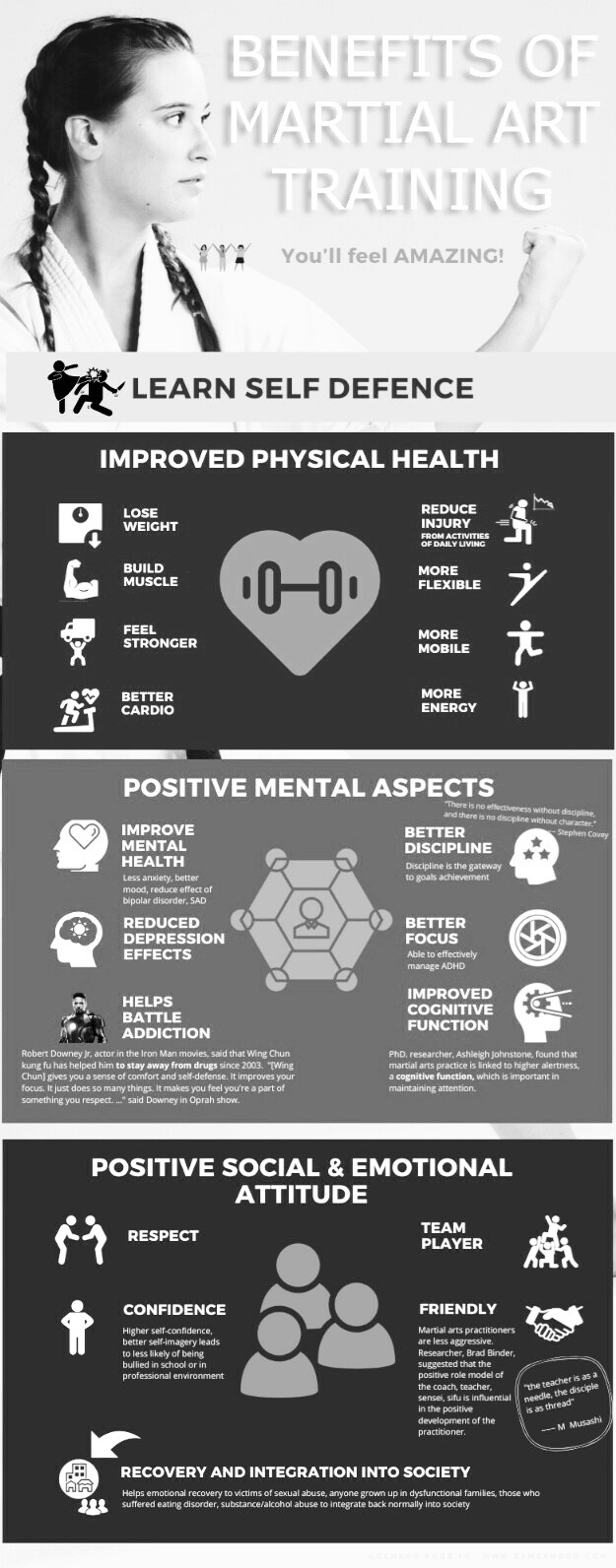
It is common knowledge that Martial arts training can provide a great number of physical benefits. Many people seek out martial arts classes in pursuit of greater fitness and to learn self defense skills, but perhaps what is less commonly known is the fact that it also has great mental, emotional and spiritual benefits.
The experience of martial arts practice is unique to every individual and training can lead to much self discovery. Most practitioners gain confidence and feel more secure in themselves as their skills improve. Some discover connections to nature’s greater force through the practice of yin/yang philosophy. Some find camaraderie with team-mates or training partners and many lose weight, gain muscle and begin leading healthier lifestyles. People often attest that they have better focus, more energy, are less stressed, and feel an overall improvement in their quality of life.

Physiological Benefits
“…there is a growing body of literature about the longer-term effects of martial arts practice. The findings of most of these studies show that the practice of martial arts leads to positive psycho-social changes in the participants…It is gratifying to know that research is beginning to support the claims of the old masters: the martial arts can help develop both better bodies and better minds and may lead to a better, more peaceful society.”

Robert Downey Jr. is a good example of how martial arts practice can help one overcome life’s great challenges. At the height of his career, addiction and substance abuse had taken control of his life. For years he was in and out of jail and rehab facilities. Then in 2003 he began practicing Wing Chun kung fu, a Chinese martial art discipline. During an appearance on Oprah, the Iron Man actor said:
“Martial arts has just been… I can’t even say how much it’s impacted my ability to stay well and focused…. It’s a spiritual practice. It’s grounded me and its primary purpose is to promote a sense of spiritual warrior-dom and to respect your society and to be prepared to defend yourself and your society if necessary.”
Enhance Attention
In an article written by Ashleigh Johnstone a PhD researcher in cognitive neuroscience at Bangor University (originally published on The Conversation theconversation.com)
“…recent research has shown a link between (martial arts) practice and improved alertness. Backing this idea up further, another study showed that martial arts practice…is linked with better performance on a divided attention task.”
Develop Perseverance
There’s more to martial arts practice besides the superficial idea of punching and kicking. The training is challenging and builds character. Honing skills for punching and kicking takes focus, discipline, perseverance, self-control and lots of practice.
Firstly, you need to make sure you have the physical conditioning to land the punches on the bag without hurting yourself. Secondly, you need to build up tolerance to pain and be ready to get cuts from skin lacerations and some friction burns while punching the bag. Thirdly, the punch delivery needs to be strong enough and directed accurately to its target. In order to overcome these challenges, you will have to possess the determination and perseverance to succeed.
Discipline, inhibitory control inherent in martial art practice
In a Psychology Today article titled Positive Psychology in Martial Arts by Neil Farber M.D, Ph.D., CLC, CPT, Neil writes:
“Regular practice of martial arts helps us gain the ability to control our emotions, desires and reactions. Martial arts teach us to think before acting, regulate our movements, and focus on action rather than reaction. The discipline involved in fine tuning and honing skills and techniques cannot be overstated…People with perseverance are more likely able to accomplish long term goals in the face of adversity. Excelling in martial arts is extremely difficult – it takes thousands of hours of practice and dedication encountering many challenges along the way to developing new skill sets…”

